 Salesforce Dev Help
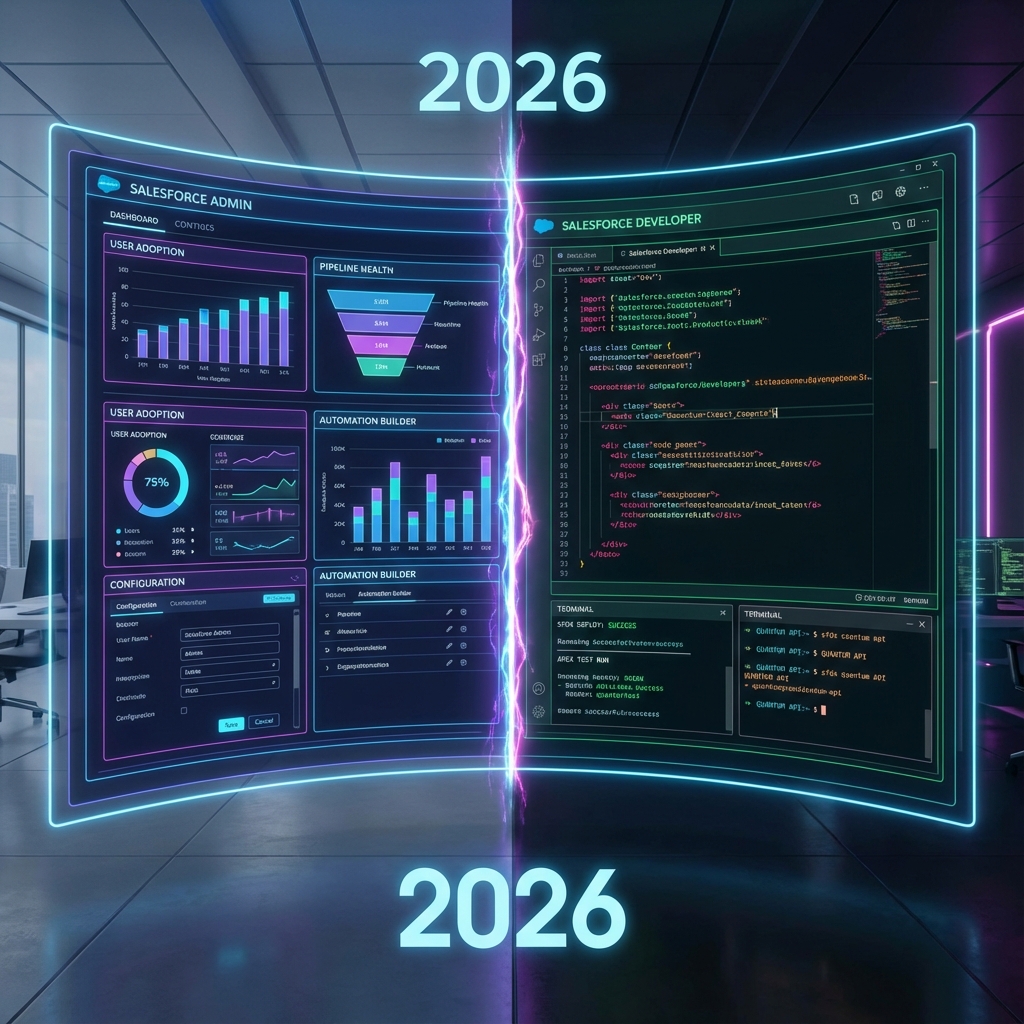
For over a decade, the question was binary: "Do you want to be an Admin or a Developer?" But as we navigate through 2026, that line has not just blurred—it has practically vanished. The rise of sophisticated low-code tools and the democratization of AI has fundamentally changed what it means to work in the Salesforce ecosystem.
However, distinct paths still exist, and choosing the right one depends more on your problem-solving style than just your ability to write code. Let's break down the reality of these two roles in 2026.
1. The Great Convergence: The "Admineloper" Era
In the past, Admins managed users and page layouts, while Developers wrote Apex. Today, an Admin uses Flow Orchestrator to build complex logic that rivals code, and Developers use Prompt Builder to configure AI without writing a single line of Java-like syntax.
The modern Admin is expected to think like a developer—understanding logic, loops, and data transaction boundaries. The modern Developer is expected to be a consultant—knowing when not to code and leveraging standard features first.
2. A Day in the Life
The Salesforce Admin (The Architect of Process) Your day is defined by business agility. You are the first line of defense and the quickest route to a solution.
- Core Tasks: Managing Flows for automation, configuring Agentforce assistants, maintaining security models, and building analytics dashboards.
- Tools: Flow Builder, Object Manager, App Builder, DevOps Center (UI mode).
- Superpower: Translating messy business requirements into elegant, scalable configuration solutions instantly.
The Salesforce Developer (The Architect of Scale) Your day is defined by complexity and integration. You step in when the platform's standard limits are reached.
- Core Tasks: Building Lightning Web Components (LWC) for custom UI, writing Apex for complex transaction logic, integrating external APIs, and managing large-scale data migrations.
- Tools: VS Code, Salesforce CLI, Git, Postman.
- Superpower: Extending the platform beyond its boundaries and ensuring performance at scale.
3. Salary & Growth Trends in 2026
While both roles are lucrative, the market in 2026 places a premium on technical depth.
- Admins: Salaries have stabilized but remain strong. The highest growth is for "Super Admins" or "Solution Engineers" who master CPQ, Field Service, or Data Cloud.
- Developers: Continue to command a premium, typically earning 20-30% more than Admins. The highest earners are those specializing in AI implementation and Commerce Cloud.
4. The Rise of Hybrid Roles
Two new distinct career paths have emerged from the middle ground:
- The Salesforce Architect: The ultimate destination for both paths. Architects design the big picture, deciding when to use code vs. config. They need deep knowledge of both sides.
- The DevOps Engineer: With the maturity of Salesforce DevOps Center, specialists who manage the release pipeline (CI/CD) are in high demand.
5. Decision Matrix: Which Path is Yours?
Still undecided? Ask yourself these questions:
- Do you love solving logic puzzles but hate syntax errors? -> Admin
- Do you want to build pixel-perfect user interfaces? -> Developer
- Do you enjoy talking to users and gathering requirements? -> Admin
- Do you want to understand how systems talk to each other (APIs)? -> Developer
The Verdict: In 2026, you cannot afford to be just one. The best Developers know the Admin features to avoid reinventing the wheel. The best Admins know enough about code to communicate effectively with Developers. Start where your passion lies, but never stop learning the other side.